
 €3,500–5,500
Straight staircase
The rail is cut to length and secured to the steps.
- Available at the earliest opportunity
- Second-hand options are often available
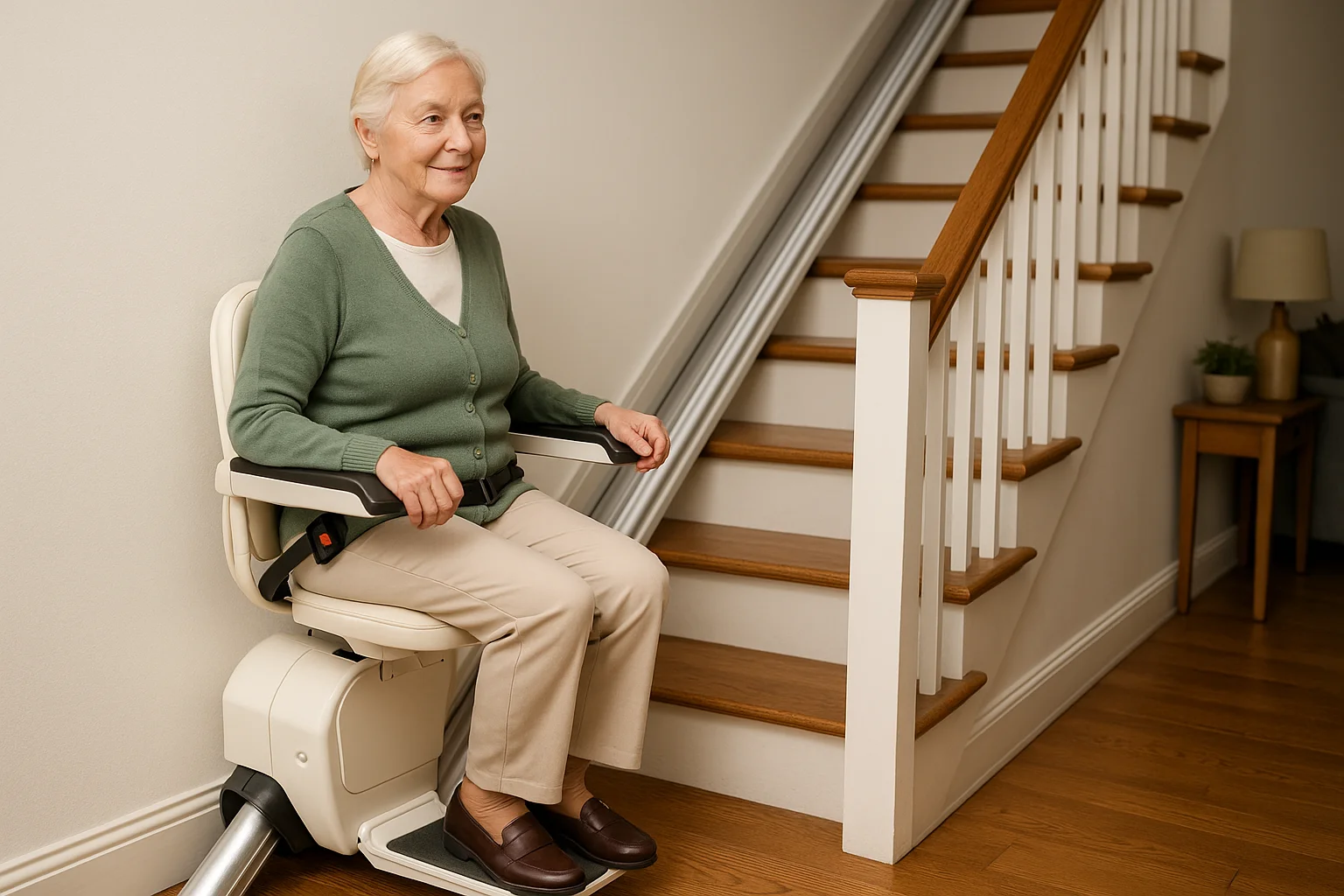
A stairlift is the most common solution for people who find climbing stairs difficult. Here you can find out how much it costs, what measurements your staircase needs and what to look out for when buying one.
From €3,500 for a straight staircase, including installation
approx. 70 cm minimum staircase width
130–140 kg standard load capacity
Runs on a battery, so it works even during a power cut
A stairlift travels along a rail up and down the stairs and is suitable for anyone who can sit securely and transfer to and from the seat. For straight staircases, it usually costs between €3,500 and €5,500; for curved staircases, between €7,500 and €12,500, including installation in both cases. When folded away, it protrudes about 30 to 40 cm into the staircase, allowing others to pass by.
As at November 2026. Edited by Regional-Treppenlift. Figures are for guidance only and are subject to change.
| Stair width | from approx. 70 cm |
|---|---|
| Load capacity | usually 130–140 kg, reinforced up to approx. 200 kg |
| Folded away | approx. 30–40 cm |
| Electricity | standard mains socket, battery operation |
| Straight installation | usually 3–5 hours |
| Installation on a curved staircase | about a day |
| Maintenance | approx. €150–300 per year |
€3,500–5,500The rail is cut to length and secured to the steps.
 €7,500–12,500
A bespoke rail follows every bend in the staircase.
 following a site survey
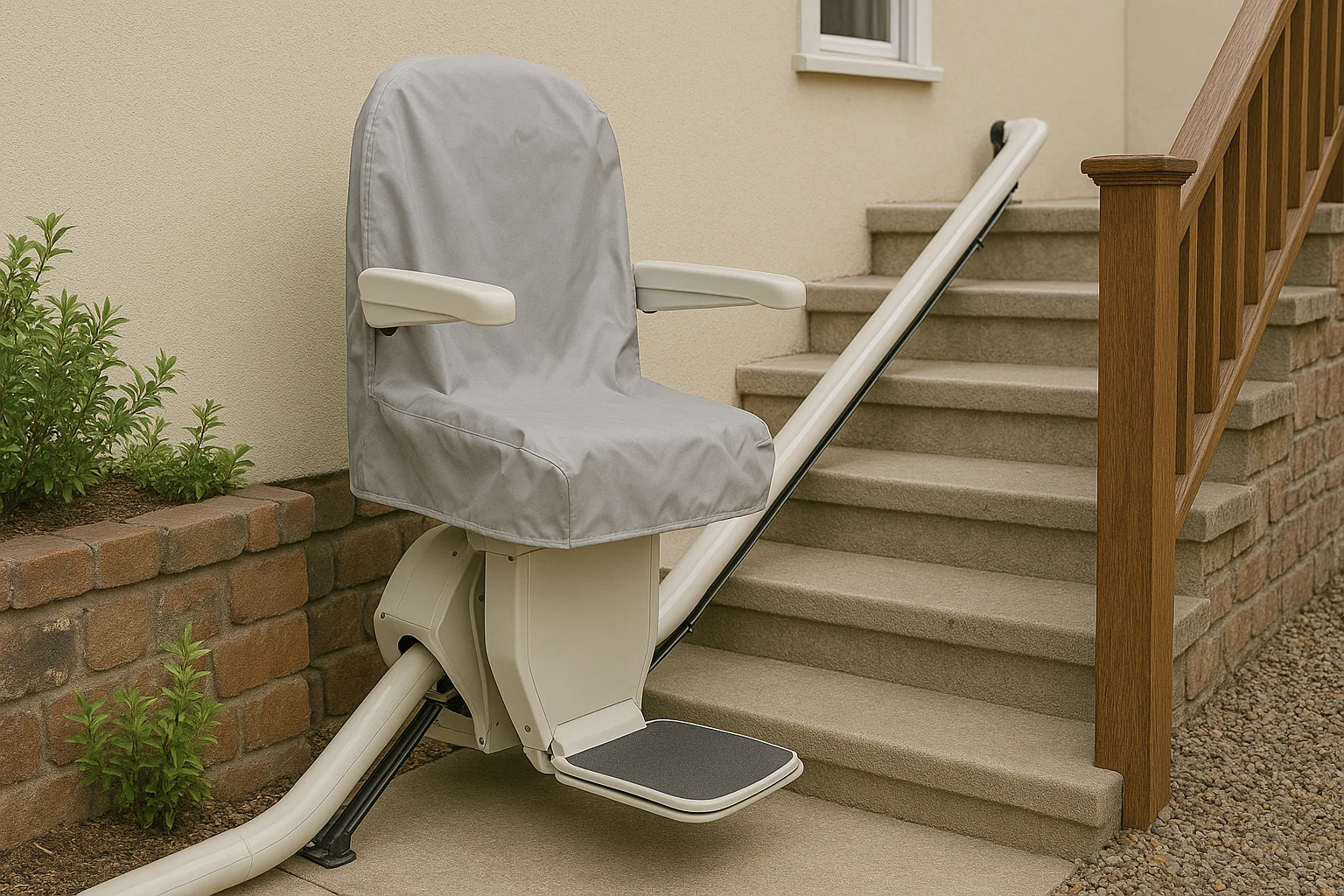
Weatherproof technology for entrances, gardens or cellars.
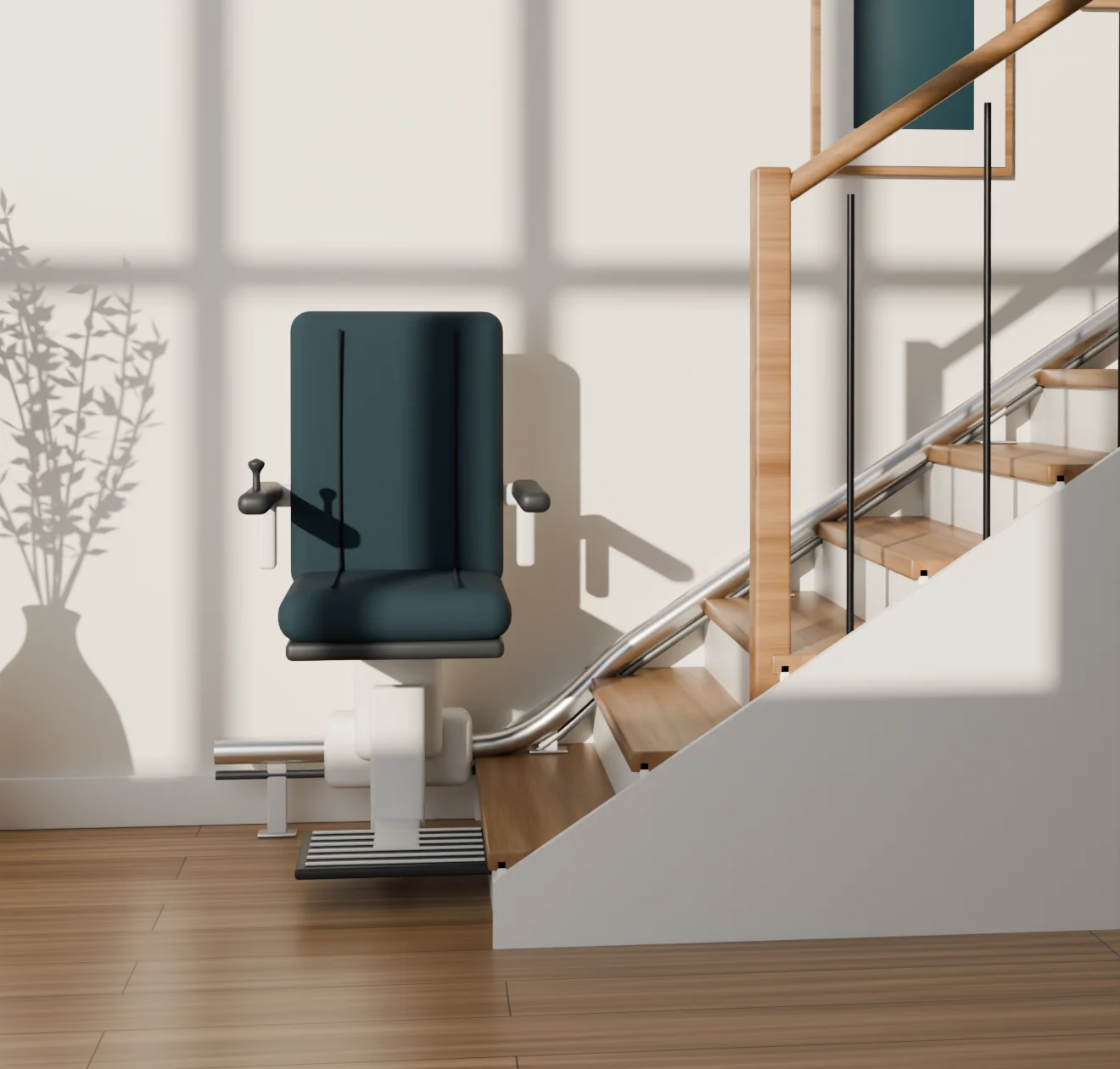
Illustrative example; no specific model is shown. Features vary depending on the manufacturer.
Safety features include obstacle detection, soft start and stop, an emergency stop button, a safety harness and a rechargeable battery that allows the stairlift to continue operating in the event of a power cut.
The basic features are standard with reputable suppliers. Extras are worth considering if they suit your situation.
A safety belt, emergency stop button and sensors on the footrest and chassis are all standard features.
The seat swivels to the side at the top so that you can stand up safely from the landing.
The lift charges whilst in the parked position and continues to operate even in the event of a power cut.
This allows you to call the lift to you when it is on another floor.
Keeps the lower passageway clear when the rail would otherwise be in the way.
For heavier users, there are models available with a capacity of up to approximately 200 kg.
We assess the staircase, mobility and care level, and provide a price range.
On-site checks are carried out to assess width, bends, power supply and safe exit.
Using this quote, you can apply to the long-term care insurance fund for the grant before placing the order.
Installation usually takes between a few hours and a day, followed by a training session.
Depending on the care level, the long-term long-term care insurance fund can contribute up to €4,180 per person. Select your situation.
Sample calculation with full subsidy. The long-term long-term care insurance fund decides on approval; the application must be submitted before the order is placed. Subsidy amount according to the Federal Ministry of Health, as at 14 September 2026.
A seated stairlift is the right choice if you can sit down safely, fasten your seatbelt and transfer to and from the lift at the top and bottom. This is often the case for people with osteoarthritis, heart failure, those who have had a stroke but can still stand firmly, or those experiencing general frailty in old age. Even those who are simply reluctant to walk up and down the stairs on their own can thus feel safer in their own home.
Things become more difficult if the person is permanently unable to transfer. In that case, a platform lift may be the better solution. In the case of dementia, you should clarify in advance whether the person can operate the lift safely or needs assistance, and practise using it together.
Involve your GP, care service or physiotherapy team if your health is likely to change. This will help you plan a solution that will still be suitable in a few years’ time.
If you live in a rented flat, you will need the landlord’s consent. Where there is a legitimate interest, such as a disability, you may be entitled to consent under tenancy law, although conditions such as removal of the lift or a security deposit may be agreed. In owners’ associations, stairlifts for people with disabilities are classified as ‘priority’ structural alterations, the implementation of which is decided by the association.
There must be sufficient width left in the stairwell to serve as an escape route. The requirements depend on regional legislation and the building itself. Clarify this before signing a contract, and ask to be shown the remaining width when the stairlift is in the parked position. Also discuss noise levels: professional installation with sound insulation keeps structure-borne noise to a minimum. Find out more under ‘Types of installation’. This is not legal advice.
Buying new is particularly worthwhile for long-term use and for curved staircases, as you’ll benefit from a warranty and the right technology. You’ll save money on second-hand models, particularly for straight staircases. Renting is a good option if the stairlift is only needed for a limited period. We’d be happy to work out the options with you.
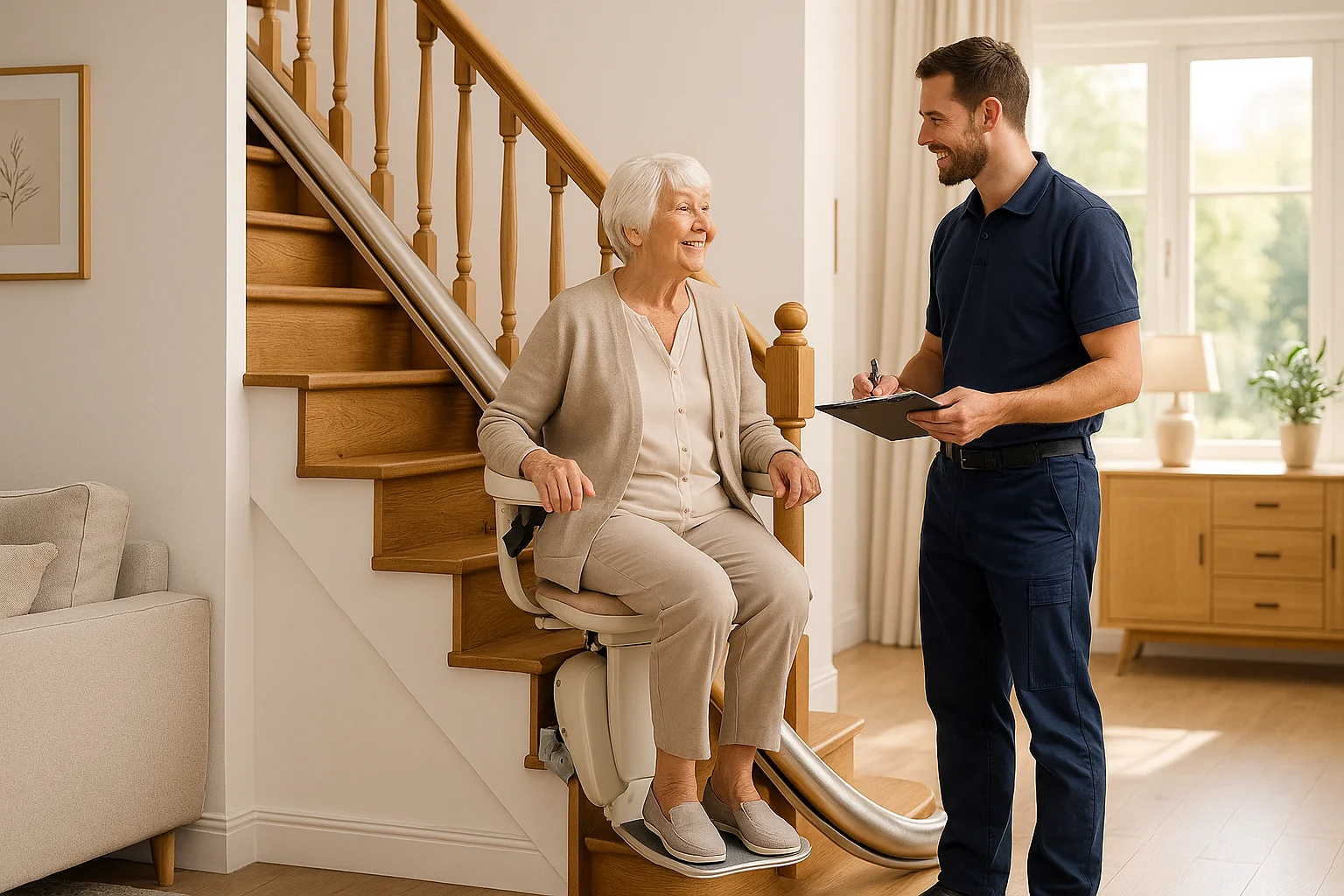
We’d be happy to answer them personally and free of charge.
Call 0800 3562673Around 70 cm is usually sufficient. For narrower staircases, slim-line models and folding sections can help. An on-site measurement is essential. In blocks of flats, the regulations regarding escape routes also apply.
The rail is usually screwed onto the steps, not to the wall. When it is removed, small drill holes remain, which can be repaired on many types of flooring.
Yes, most models run on rechargeable batteries and can still manage several trips.
Yes. The seat, armrests and footrest fold up. It is parked at the top or bottom, preferably out of the way of the walkway.
Certified systems are designed for use and must be manufactured in accordance with the European standard EN 81-40 and the Machinery Directive. Ask to be provided with the CE declaration and the acceptance certificate.
Depending on the care level, the long-term long-term care insurance fund may cover up to €4,180 per person. You are responsible for the remainder, often with support from state funding or the KfW Loan 159. Health insurance funds do not usually contribute.
The initial consultation is free of charge and without obligation. This applies even if you are enquiring on behalf of your parents.
This page was translated automatically with DeepL. If in doubt, the German version applies.
